Jeremy Hill-Douglas
My Profile
-
Student #
s3668805 -
Email
s3668805@student.rmit.edu.au -
Web
jeremyjhd.github.io/Assignment-1/
Personal Information
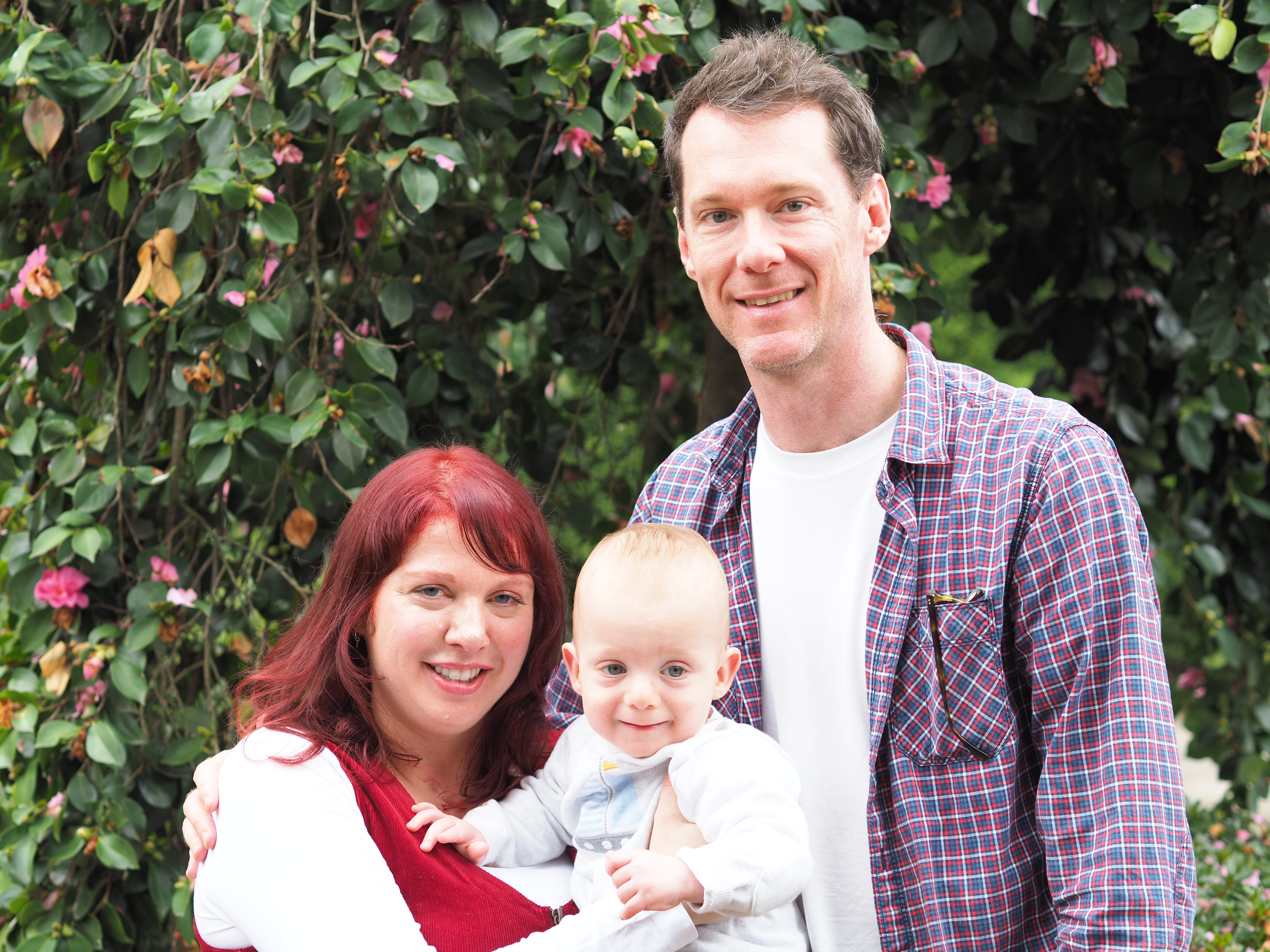 My name is Jeremy, and I am studying a Bachelor of Informational Technology (IT) through the RMIT Open University program. On this page you will find information about me, what IT means to me now, and where I would like to go with it in the future, as well a personal idea for an IT project that I would love to see developed.
I am a 37-year-old home-espresso enthusiast, SCUBA-diving fanatic, living in Sydney with my wife Ally and our 1-year-old son Alfie. I grew up in central Queensland, where Mum and Dad operated a large sheep station. We moved to Brisbane around the time I started high-school, and since then work has taken me up and down the coast between Brisbane and Melbourne.
Finishing up high-school, I was interested in working in aviation, and drawn to a career as an air traffic controller. While controlling aircraft was exciting and engaging, I never felt comfortable in the job so later decided to hang up the headset and moved into aviation operations, where I continue to work today.
Interest in IT
I have had an interest in IT since high school, probably starting with games and building and upgrading PCs. This led to taking up IT as a school subject, where I had my first exposure to programming and databases. I was particularly drawn to the logic and problem-solving nature of programming, experimenting through trial and error to reach an objective. Facing a problem and applying my skills in new ways to solve it really appealed to me.
Since working in the aviation industry I have been continually exposed to IT on the user side. Recently I have been involved in shaping the development, testing, and implementation of proprietary software used to manage flying operations. Problem-solving issues again has reignited my interest in IT and led me to pursue studies at RMIT.
The RMIT IT program stood out to me as a great option to further explore the world of IT. Ideally, I would like to move into more technical job roles that relate to my aviation industry experience. The program’s mix of delivering a broad IT knowledgebase with key technical skills may also open my eyes to something altogether new.
Through my studies I hope to gain a broad depth of knowledge across the fundamental aspects of IT as well as the basis to continue to build expertise in fields I am drawn to beyond the degree. I also aim to gain contemporary technical skills which I can begin to apply in the short term, enabling me to use technology to innovate work practices in my workplace. Applying my own experience with newly taught skills, I expect to further develop all-important skills of collaborative work in an IT context.
Ideal Job
To further illustrate what IT means to me, I have selected a job that appeals to me as a possible goal in my IT journey. By describing what appeals to me about this job and outlining a proposed path to achieving it, I hope to convey a bit more about myself.
Position Description
Job Advertisement - Software TesterSigma Bravo provide IT services to the Australian Defence Force, with a focus on aerospace software solutions. The role I am drawn to is that of a Software Tester, working in an agile Software Development team supporting an integrated flight scheduling and management software system used by military flying units.
This position appeals to me as it draws together elements of my aviation industry experience, with aspects of IT that interest me. The position requires developing and undertaking software testing procedures and strategies including automated testing, working closely with the software development team to resolve issues, and ultimately ensuring a quality product is provided to the Defence Force.
I am drawn to the hands-on nature of the position, operating the software from the perspective of the developer and the user, facilitating the bridge between user requirement and technical implementation. I’m particularly interested in the problem-solving nature of the position. Identifying issues and working in collaboration with the broader team to resolve them would be a frequently rewarding part of the job.
Position Description
Sigma Bravo are looking for an IT or Engineering qualified candidate. Requiring 3 years prior experience in a similar role, it is not a senior position, but does require the candidate to have proficiency in software testing practices, such as setting up test environments and performing test execution. Specific to this core skill, an ISTQB Software Tester certification is desirable.
Collaboration is important in this role, with specific experience working in an Agile team a requirement. The Agile development process is focused on quickly delivering iterative working solutions with the ability to refocus the team’s objective as customer needs change or new ones emerge. Rather than a protracted project which aims to deliver an all-encompassing solution at its end, agile projects deliver prioritised elements and capability for quicker release and feedback from the customer (Atlassian, 2021). Aligned with this methodology, the role requires strong analytical skills and a methodical team focused approach. Specific to this role, collaboration is across technical and non-technical audiences, so strong communication skills are essential.
Being Defence contractor, governance features heavily across the company’s projects. The role requires experience in technical documentation production and looks favourably on specific experience in military standards.
Finally, Sigma Bravo would also look favourably on a candidate with specific technical experience or knowledge in the Microsoft software development and test product stack and SQL queries.
Relevant Skills I have
I believe I have some foundational skills and experience that apply to this position. I have been directly exposed to the operation, testing and development of aviation software systems from a user side and understand the safety-critical environment in which they are used.
Working in an operations centre, I see parallels to the agile methodology. We deal with competing priorities regularly and must utilise the team’s different functions to quickly respond to emerging issues.
As an air traffic controller, I used and contributed to technical documentation regularly. I understand the attention to detail required to maintain these products. I have also developed a methodical approach to tasks that is required in the aviation industry, both in a collaborative and individual setting.
Path to Gaining the Skills and Experience Required
Completing a Bachelor of IT will be the first significant step towards this goal. Throughout the degree I will develop the foundational technical skills with which to later build upon with relevant software testing specialist skills and qualifications. I will be directly exposed to collaborative IT work while developing communication skills, particularly as they apply to technical and industry specific practices. I will gain some basic skills assumed in this position, such SQL, and have opportunity to develop analytical skills in the context of IT issues.
Further to university, additional industry education would put me in good standing. Software Tester specific certifications such as the desirable ISTQB would feature highly on this list. Outside of formal education, I believe technical skills are a perishable asset and require continued focus. This requires self-motivation to not only maintain these skills, but to keep them contemporary through informal and formal self-education across broad topics.
Seeking initial IT positions to build relevant experience may entail leveraging my industry experience to move into a more technical role in the aviation industry. Ultimately the focus of this position is software testing and attaining a junior or graduate position in this field would be an ideal first move.
Myers-Briggs Profile
16 Personalities - ISTJ Personality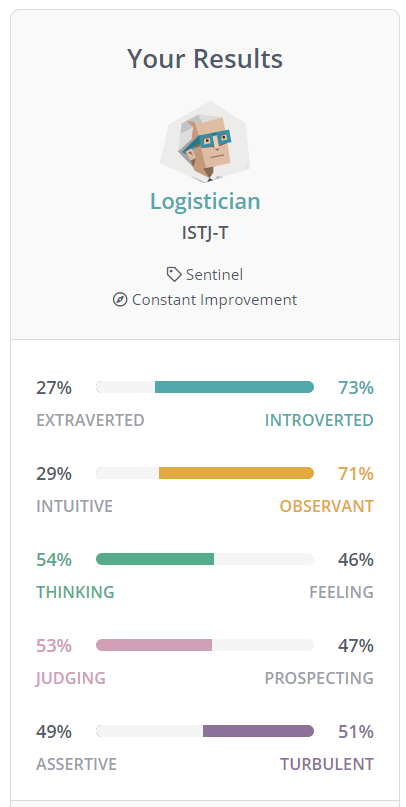 According to the Myers-Briggs Test I am an ISTJ-T, or ‘Logistician’ personality type. Defining characteristics of integrity, practical logic and tireless dedication to duty make up the Logistician personality profile.
Traits of the Logistician:
- Practical logic
- Preferring autonomy to a reliance on others
- Value honesty above emotional considerations, which can be seen as a blunt approach and leave a cold impression
- Tendency to keep opinions to self
- Calm and practical
- Can be stubborn to new ideas or change
- Strong opinion on how things are done
- Reluctant to give up responsibility even when overburdened, or if there is a better person for the job
- Can be inflexible
- Require clearly set steps and well-defined responsibilities
- Valuing stability, innovations and brainstorming of new ideas can disrupt
- Preference to operate by the book which can create aversion to innovation
- Can be tripped up where a practical and methodical approach limit developments
I believe my Myers-Briggs Test results largely ring true in their descriptions and analysis of my personality. I am certainly an introvert, and the profile correlates with my tendencies to preference autonomous work and in keeping opinions to myself, relying on my actions and work to speak for me. I found the test results particularly interesting in identifying traits which I would agree with upon consideration, but perhaps was not otherwise consciously aware of. This included a reluctance to give up responsibility to others even when overburdened myself. By being aware of these traits, I can take steps to draw on my strengths, and avoid their pitfalls.
Learning Style Profile
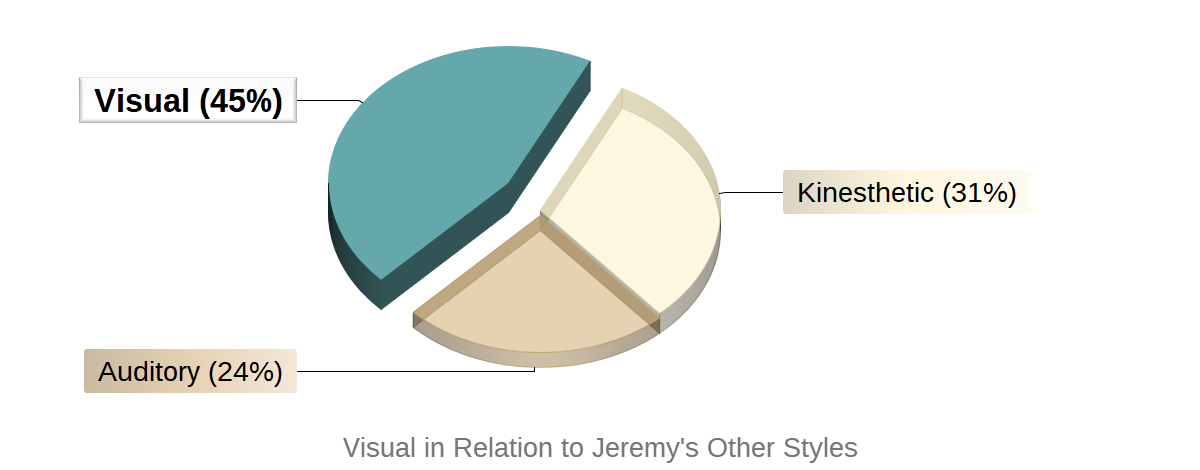
Personality Max - Learning Style ResultsAccording to tests that assess preferences for visual, kinaesthetic, and auditory learning styles, I am primarily a visual learner.
Visual Learners
Visual style is learning by seeing. You learn visually whenever you gain information from sight. This includes more than just the viewing of pictures and your surroundings. Visual learning also encompasses the written word.
Visual learners benefit greatly from teaching that utilizes illustrations, charts, diagrams, videos, etc. They often feel a need to convert spoken instruction into visual form by taking notes.
 Traits of the Visual Learners:
- Good at remembering people's faces
- Accurately recognises body language and facial expressions
- Able to picture things in their mind
- Good at taking notes in the form of text and doodles
- Comprehends visual information such as charts, graphs and diagrams
- Recalls appearances with ease
- Appreciates pictures and illustrations in books
- Enjoys learning from video presentations
- Learns well from flash cards
- Notices visual details that others might miss
Awareness of your preferred learning styles is important in directing efforts in university, work, and life more broadly. Again, this testing confirmed my self-assessment that visual learning suits me. Testing did raise some valuable self-reflection of my preference for written word in understanding a topic. I have always valued illustrative detail when learning, but I think written word equally suits my preferred learning style.
Big Five Personality Profile
Big Five Test Results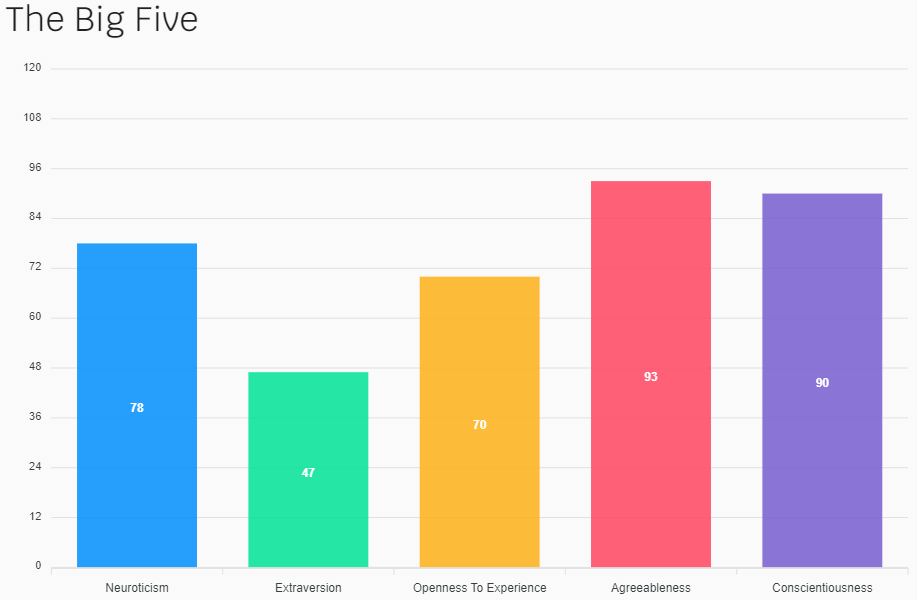 According to the Big Five Personality test, that measures OCEAN dimensions of personality - Openness, Conscientiousness, Extraversion, Agreeableness, and Neuroticism – my personality traits measure as follows:
This testing highlighted to me a tendency for negative feelings. This is something I was not consciously aware of but is something to consider. Testing affirmed many of my own assertion and aligned with Myers-Briggs Testing that I am introverted and more practical than imaginative. I considered the high agreeableness value somewhat at odds with the stubbornness trait indicated in the Myers-Brigg. This duality is something to be aware of, it explains a tendency to concede where I should stand my ground.
How Do These Results Influence My Behaviour In a Team?
Working in a team, I am likely to assume followership roles. I would do well to consciously speak my mind where I may be inclined to hold back. I may resist change or new ideas in a group setting, particularly where previous methods have been established. Being aware of this, I should both keep an open mind, and value creative ideas from others. I am likely to resist giving up responsibility so should consciously consider my own capacity and strengths when work is assigned and delegated. As a visual learner, I may not always grasp ideas and concepts that team members communicate verbally. Aware of this, I may need to carryout my own research on topics through preferred visual methods.
How Should I Take This Into Account When Forming a Team?
When forming a team, it is important to seek out input from others that may compliment my strengths and weaknesses. I should seek out creative and outspoken types that can challenge my beliefs and offer new ideas. Having self-awareness of my own traits, I should make efforts to be open with team members where I may be inclined to withdraw.
Project Idea
Overview
Information Technology seems to find a way into every aspect of our lives. Our sport and hobbies are no exception. I have developed an idea for a project that aims to use Information Technology to improve the safety and enjoyment of SCUBA divers, free divers, and snorkelers (collectively referred to as divers).
The concept of the project is a mobile-based application titled Diving Zen that assesses diving conditions and informs divers’ decision making when selecting where and when they dive. Assessing diving conditions can be a complex process, with multiple variables to consider, and it is particularly challenging for inexperienced divers. Misjudging conditions could mean an unpleasant experience at best, or worse it could place divers in significant danger. Information Technology can assist in this process to ultimately improve the enjoyment and safety of divers.
Motivation
As an avid SCUBA diver, I have experienced first-hand the frustrations of diving in poor conditions that I could have avoided by properly assessing conditions before leaving the house. A calm and clear day according to the local weather report may not be the case in the water. Ideal diving conditions can quickly deteriorate, catching out unaware divers during a dive.
Assessing diving conditions requires an understanding and consideration of a range of factors. Divers must interpret different weather forecasts, looking at wind, tides, swell strength and direction, and consider how these factors affect their specific dive site. At the basic to intermediate levels of training most recreational divers receive, assessing these conditions is rarely covered and poorly understood. Instead, divers rely on the experience of others and often their own misadventures to guide them.
Information Technology offers a solution to this problem. The Diving Zen mobile application concept can assist the diver by gathering a range of weather and marine forecasts (collectively referred to as forecasts), assessing these across a range of dive sites, and predicting diving conditions at those sites. For the inexperienced diver, interpreting this information would help them make better decisions, get more enjoyment from the sport, and be safer in doing so. For experienced divers it offers a quick reference tool that compiles information they would otherwise have to seek out across multiple sources, simplifying their diving experience.
Description
The mobile application, Diving Zen offers the following key functions:
- Compiles forecasts that are relevant to diving conditions for multiple dive sites
- Interprets these forecasts to predict diving conditions at individual dive sites
- Recommends dive sites based on predicted diving conditions, and importantly the ideal time to dive
- Describes the impact that forecast conditions have upon diving conditions at specific dive sites
User Inputs
The application is controlled by the user entering a range of optional inputs that define what dive sites will be searched and assessed.
- Date/Time range. User nominates one or multiple date/time ranges they would like to dive
- Dive duration. User nominates intended duration of dive in a range from 30 minutes to 3 hours. This element is important as conditions may be such that you commence a dive in good conditions, but they worsen to the point of being unsafe during the dive, such as in regions with significant tidal effect
- Day/Night dive. User nominates if they are looking to dive during daytime, night-time, or both. The application will determine local dawn and dusk times to apply to search windows
- Preferred dive sites. Limits search to specific dive sites the user nominates
- Search area. Opens search to any dive sites within a specified distance from user
Application Outputs
- Dive sites. Lists all dive sites the user has selected, or within the nominated distance. Sites are sorted in order of best predicted diving conditions. User may alternatively sort list by distance
- Recommended dives. Lists the date/time assessed to have the best diving conditions at each site
- Diving conditions timeline. Provides a colour-coded timeline indicating the predicted diving conditions (in accordance with the diving conditions prediction assessment described below) at each site over the date/time range selected by the user
- Forecasts. Displays a consolidated weather and marine conditions forecast at each site in the search area, during the date/time range selected. An explanation of how these conditions affect diving conditions is provided for the user to refer to, intended to educate and develop their understanding of this process
Diving Conditions Prediction
The most important and innovative aspect of the application is its interpretation of forecasts to predict diving conditions. The application assesses conditions into five categories (Excellent, Good, Average, Poor, Dangerous) making it easy for the novice-diver to consider conditions. This assessment is based on several factors:
- Tidal windows. Best diving conditions occur during hightide. Incoming or outgoing tide can create dangerous conditions which divers need to plan for
- Recent rainfall. Recent rain results in poor visibility in the water and unfavourable conditions
- Wind strength and direction. While calm wind is favourable, the wind direction can be as important as its intensity in assessing diving conditions. A moderate onshore wind can create chop and unpleasant diving, while a strong offshore wind may be benign to a protected diving site
- Ocean swell. Swell strength and direction affects sites differently, and may cause unpleasant or dangerous conditions
Geospatial Information
In order to assess conditions at specific sites, the application requires access to geospatial information. Google Maps Platform provides multiple Application Programming Interfaces (APIs) that enable the integration of their maps and geospatial information into an application.
Dive site locations are to be input by individual users through a familiar pin-drop mapping function. By sourcing this information from users, it enables the application to be scaled as its use increases, without having to supply an initial database. Using this data, the application will assess effects of forecasts against the specific geography of each dive site, such as wind direction relative to shore direction and impacts of ocean swell.
Forecast Data
Central to the application’s function is access to reliable weather and marine forecast information. The Bureau of Meteorology makes available real-time forecast, warning and observation products and analysis charts. These products are available freely for authorised purposes, and as client data services that can be used for commercial products.
Machine Learning Enhancements
Machine learning could enhance the application’s diving conditions prediction function. While the application applies general principles of weather effects and interprets geographic influences, certain dive sites will be more or less sensitive to these effects. By integrating a user feedback system, user reports of diving conditions can be compared with forecasts to inform improvements to the diving conditions prediction algorithm. For example, a site that is more sensitive to swell will adjust the influence that swell conditions have on predicted diving conditions.
Tools and Technologies
The Diving Zen application is ideally suited to a mobile platform, as users are likely to be accessing it away from home, retrieving updates at or enroute to their dive site. In my research I assess that this would best be developed with cross-platform (hybrid application) development tools, rather than building for individual mobile platforms. (Chebbi, 2019)
Using a common programming language that can support both the iOS and Android platforms would be an efficient strategy for an individual or small group to approach this project. C# (C Sharp) is an object-oriented programming language that can be used to develop on both platforms. The Xamarin framework allows developers to access native iOS and Android capabilities with C#. (Chebbi, 2019)
Using machine learning tools to perform predictive analysis to compare user feedback with predicted diving conditions would require additional tools and technology. Open-source tools are available across different programming languages that could enable this. Core ML is one open-source tool that can integrate machine learning into applications. (Core ML, 2021)
Due to the application’s requirement for databases updated with dive site information received from users, and the potential integration of machine learning enhancements that utilise a user feedback system, Diving Zen would also require back-end cloud-based services to support these elements. Services like the BuildFire JS framework would offer access to these functions and tools through an open-source environment, avoiding the need to build it from scratch. (Buildfire, 2021)
Skills Required
The primary technical skills required to develop this project are general programming skills, and the specific languages used for this project. Options such as the MIT App Inventor enable the development of applications without programming knowledge, however I do not believe these tools provide the capabilities needed to build the machine learning aspects or back-end services required for the complete project.
Developing these skills from scratch would require significant effort but there are myriad options available for self-education or online courses that provide flexible education options. The proliferation of learning platforms such as Udacity and Code Academy compliment traditional education options, and make it possible for novice or experienced developers to seek out these skills.
Outcome
This project has the potential to make a real improvement to the sport of diving. This is particularly true for beginner divers that lack the experience and skills to judge diving conditions. For divers starting out in the sport, this inexperience will often mean they have negative experiences, possibly being put off the sport altogether. In extreme cases, they may be putting themselves into real danger.
By providing a stable and accurate way to predict dive conditions, divers will have more enjoyable and safer experiences, avoiding some of the pitfalls of inexperience. Implementing machine learning enhancements would enable the application to continually evolve, further improving divers’ experiences and safety in their sport.